60 Pitches. 22 Yeses. 1 Million Dollar Bet
In 1994, raising $1 million for a business selling books on the internet felt more like science fiction than venture capital. Bezos pitched 60 investors, many of whom had never even heard of the internet. He had to start most meetings by explaining what it was — before daring to suggest it would one day host the world’s largest bookstore.
Only 22 investors said yes, including his parents, who invested $250,000. Each put in around $50,000, betting not just on the market, but on Jeff. He told them there was a 70% chance they’d lose it all. That first $1M funded Amazon’s early servers, staff, and startup stock. It wasn’t a fairytale. It was a bet on vision, grit, and a founder who refused to wait for permission.
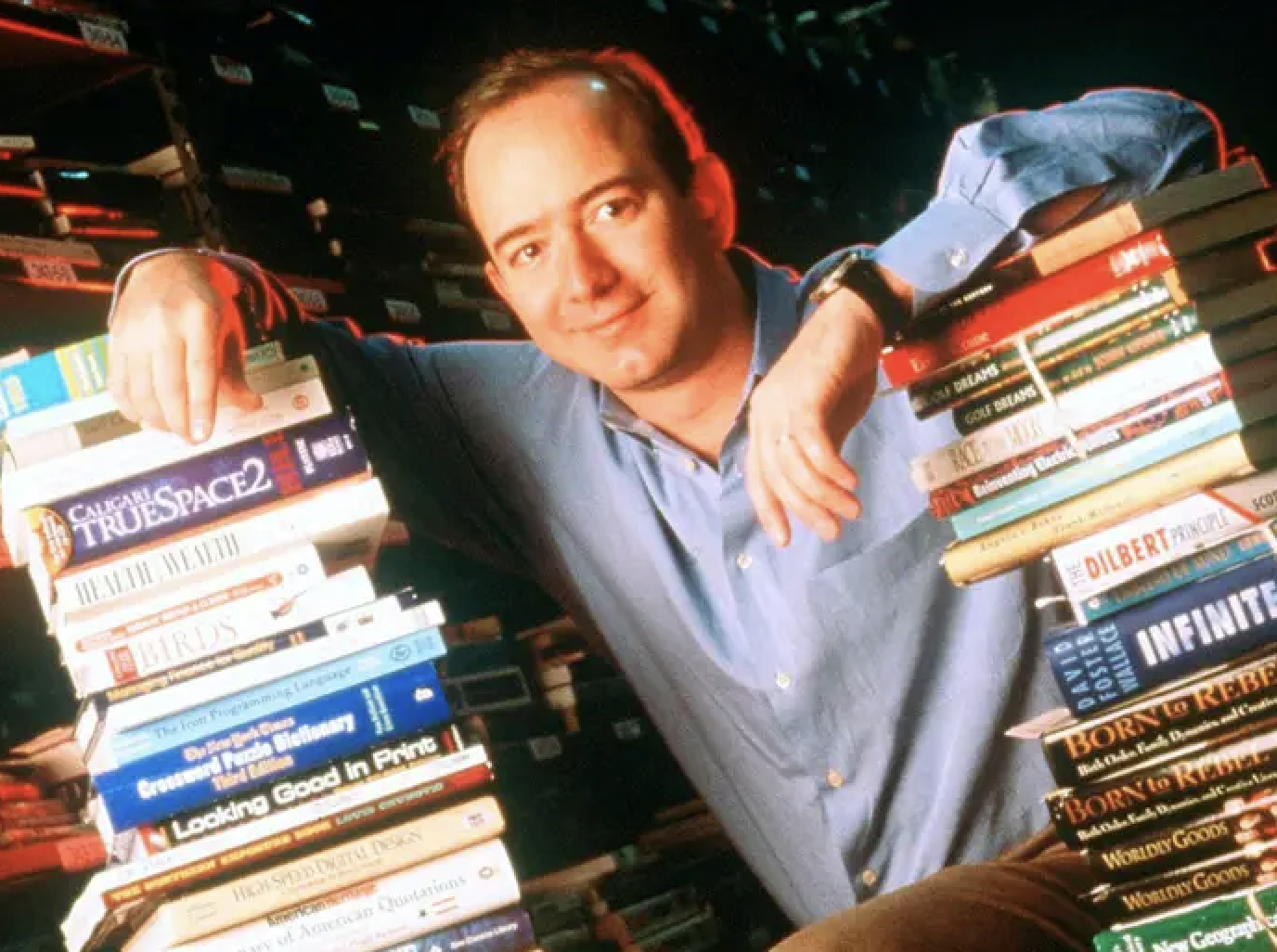
Jeff Bezos 1995
Obsess Over Customers, Not Competitors
Bezos made it clear from day one: Amazon would be customer-obsessed. That focus wasn’t just branding — it was a strategic weapon. Every decision centered around delivering better prices, faster delivery, and more convenience. While other companies watched their competitors, Amazon watched its customers.
This obsession powered inventions like 1-Click ordering, Prime, and customer reviews. It also let Bezos ignore short-term profits to play the long game — reinvesting everything into growth, infrastructure, and innovation. It’s a mindset that would help Amazon outlive most of its dot-com peers.
“Your Margin Is My Opportunity”
Bezos saw inefficiency as an open invitation. His now-legendary quote — “Your margin is my opportunity” — reflected a core belief: if something is expensive, slow, or complicated, there’s a better way. That insight drove Amazon to take on everything from publishing to logistics, cloud computing, AI, and media.
Where others feared thin margins, Bezos used them as weapons. He pushed Amazon to scale relentlessly, embracing automation and investing in systems that would create long-term cost advantages. Behind the quiet voice and awkward laugh was one of the most lethal strategic thinkers in business history.
Amazon's IPO in 1997
From Dot-Com Collapse to Global Infrastructure
Amazon went public in 1997 at $18 per share. When the dot-com bubble burst, Amazon was still losing hundreds of millions per year. The stock lost 90% of its value. Analysts wrote it off. Many expected it to disappear.
But Bezos didn’t flinch. Instead, he laid the groundwork for Amazon’s next phase — building warehouses, streamlining delivery, and launching Amazon Web Services in 2006. AWS would become the silent engine behind much of the modern internet, and Amazon’s most profitable arm.
Today, Amazon isn’t just a store. It’s a cloud platform, streaming giant, AI lab, logistics network, media empire, grocery chain, and soon, a healthcare provider. A company born from a book idea now touches every part of life — and it’s worth over $2 trillion.
From Book Nerd to Industry Titan
Jeff Bezos began as a quirky coder with a weird laugh, high-pitched voice, and a whiteboard full of stats. He looked more like a math teacher than a mogul. But as Amazon grew, so did he.
He evolved into a global titan — physically, mentally, and strategically. From awkward to authoritative, from founder to force. He built Blue Origin to make space travel viable. He bought The Washington Post and modernized it. He became one of the richest and most influential people in history — yet still anchored in the long-term mindset that powered it all.
His journey is proof: transformation doesn’t just happen to companies — it happens to people brave enough to build them.
Jeff Bezos 2025
A few pieces of Jeff Bezos wisdom that capture the essence of how he thinks, leads, and wins:
- “If you’re competitor-focused, you have to wait until there is a competitor doing something. Being customer-focused allows you to be more pioneering.”
- “I knew that when I was 80, I wouldn’t regret trying this. I would regret not trying.”
- “We are stubborn on vision. We are flexible on details.”
- “A brand for a company is like a reputation for a person. You earn reputation by trying to do hard things well.”
- “Your margin is my opportunity.”
- “If you never want to be criticized, for goodness’ sake don’t do anything new.”
- “One of the only ways to get out of a tight box is to invent your way out.”
- “The best customer service is if the customer doesn't need to call you, doesn't need to talk to you. It just works.”
- “In the short term, the stock market is a voting machine. In the long term, it’s a weighing machine.”
- “In the end, we are our choices. Build yourself a great story.”
About the Author: Peter Terrill is the Director & Chief Venture Design Officer of V1 Scale and a thought leader in Success Architecture. Having navigated large-scale corporate environments, he now focuses on building resilient, high-growth digital pipelines. You can follow his personal journey and insights at www.peterterrill.com