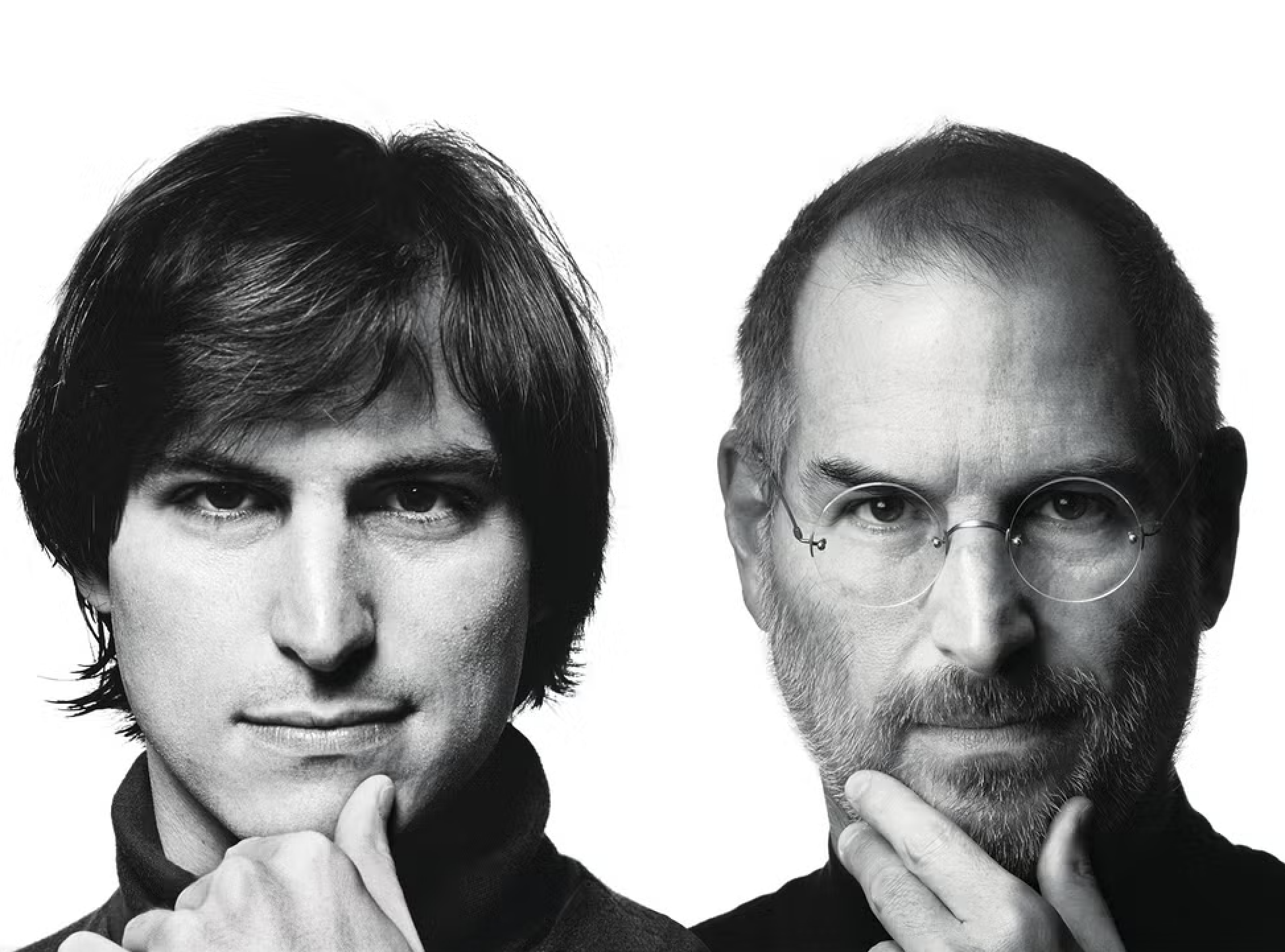
Quotes and powerful insights from Steve Jobs
“Your work is going to fill a large part of your life, and the only way to be truly satisfied is to do what you believe is great work. And the only way to do great work is to love what you do..”
“Innovation distinguishes between a leader and a follower.”
"The people who are crazy enough to think they can change the world are the ones who do"
"Stay hungry, stay foolish"
The journey of the crazy one
Steve Jobs was born in San Francisco in 1955 and raised in the heart of Silicon Valley. His early years were marked by a mix of curiosity, rebellion, and an unrelenting drive to break boundaries. Jobs didn’t take the traditional path to success. In fact, he dropped out of college after just one semester, a decision that baffled many at the time but was a pivotal turning point in his life.
Rather than continuing his formal education, Jobs chose to follow his passion for technology and design, and that decision would change the world forever.
It was in his garage in 1976 that Jobs, alongside Steve Wozniak, co-founded Apple. Their mission? To create personal computers that would revolutionize the way people interacted with technology. Little did they know that this would be the beginning of a revolution that would reshape entire industries.
Steve Jobs garage, the birthplace of the world’s first $3 trillion company.
It all began with the Apple 1. In 1976, Jobs and Wozniak created their first computer, an unassuming yet groundbreaking machine that would later become known as the Apple 1. As the first product that bore the Apple name, the Apple 1 had no flashy design or sleek packaging—what it had was raw potential. This humble circuit board, assembled by hand in Jobs' parents' garage, marked the first step in what would become the world’s most valuable company.
The Apple 1 was a personal computer unlike any other at the time, introducing the concept of a machine that could be used by individuals at home, rather than just businesses or research institutions. Though it was far from perfect, the Apple 1 laid the foundation for everything that followed: the drive for innovation, simplicity, and user-centric design.
Everything that would make Apple the most valuable company in the world—its commitment to pushing boundaries, simplifying technology, and creating products that people loved—began with this small, scrappy computer. It’s a testament to how even the most extraordinary legacies start with a single, humble idea.
Failures, Setbacks, and Rejection
The path to success was far from easy. Like many entrepreneurs, Jobs faced numerous challenges, from financial struggles to technical hurdles. Apple’s early products were far from perfect, and the company went through rough patches in its infancy. Jobs was fired from his own company in 1985, an event that could have crushed anyone's spirit. However, instead of letting failure define him, Jobs used this setback as an opportunity for growth.
During his time away from Apple, Jobs founded NeXT, a company focused on building high-end computers for the higher education market, and bought Pixar, a small animation studio that would eventually become a global powerhouse. Through these ventures, Jobs learned invaluable lessons about leadership, creativity, and innovation. His time away from Apple gave him the space to reflect, refine his ideas, and, ultimately, return to Apple in 1997 with a vision that would set the stage for the company’s meteoric rise.
The Apple Revolution: Thinking Different
When Jobs returned to Apple, the company was on the brink of collapse. But Jobs had a different vision—one that was centered around user experience, sleek design, and creating products that combined functionality with simplicity. His mantra, "Think Different," became the guiding principle for the entire company.
The launch of the iMac in 1998 was the beginning of Apple’s revival. It was a product that was not only groundbreaking in terms of design but also marked a fundamental shift in the way people viewed computers. Jobs followed this success with the introduction of the iPod, the iPhone, and the iPad—all of which redefined their respective industries. With each new product, Jobs challenged conventional thinking and pushed the boundaries of what was possible, creating products that were as much about emotion and experience as they were about technology.
Jobs also revolutionized the business model by integrating hardware, software, and services into a seamless ecosystem. This integration made Apple products more than just gadgets; they became lifestyle statements. The App Store, iTunes, and the launch of the first truly mobile computer with the iPhone changed the way people lived, worked, and communicated.
What Entrepreneurs Can Learn from Steve Jobs
1. Innovation Requires Risk: Steve Jobs wasn’t afraid to break from tradition. He knew that true innovation could only come by challenging the status quo. As an entrepreneur, you have to be willing to take risks and make bold decisions, even if others don’t understand your vision at first.
2. Failure Is a Stepping Stone: Jobs faced numerous failures, from his ousting at Apple to the challenges in his early ventures. However, instead of letting failure define him, he learned from his mistakes, grew stronger, and came back even more determined. Entrepreneurs must learn to embrace failure as a necessary part of the journey, as it often provides the most valuable lessons.
3. Design Matters: One of Jobs’ core beliefs was that design wasn’t just about how something looked—it was about how it worked and felt. Entrepreneurs can learn from Jobs’ obsessive attention to detail in design, ensuring that every aspect of their products and services resonates with users on an emotional level.
4. Focus on User Experience: Jobs was relentless in his pursuit of creating products that weren’t just functional, but beautiful, intuitive, and easy to use. Understanding your customer’s needs and delivering an experience that exceeds their expectations should always be a priority for any entrepreneur.
5. Build a Strong Team: Although Jobs was a visionary, he knew that success couldn’t be achieved alone. He built a team of talented individuals who shared his passion and commitment to excellence. As an entrepreneur, surrounding yourself with people who complement your skills and share your vision is essential to building a successful venture.
6. Perseverance Pays Off: Jobs’ career was marked by many setbacks, but his persistence was key to his eventual success. He never gave up on his vision, even when it seemed impossible. Entrepreneurs must possess a similar resilience, continuing to push forward even when faced with challenges or setbacks.
The Legacy of Steve Jobs
Steve Jobs’ legacy extends far beyond the products he created. His vision and leadership style shaped an entire industry and continue to inspire entrepreneurs around the world. He demonstrated that innovation doesn’t come from simply following trends—it comes from seeing the world differently, taking risks, and staying true to your vision.
While Jobs may no longer be with us, his influence is still deeply embedded in the technology we use every day. His story is a powerful reminder that to succeed as an entrepreneur, you must be willing to dream big, embrace failure, challenge conventions, and relentlessly pursue perfection. The world needs more “crazy ones” who dare to think different and push the boundaries of what’s possible.
What Can Entrepreneurs Learn from Steve Jobs?
- Embrace risk and challenge conventional thinking.
- View failure as a stepping stone to success.
- Prioritize design and user experience.
- Build a strong, dedicated team.
- Persevere through adversity and stay committed to your vision.
Just like Jobs, entrepreneurs today have the power to change the world—one bold, innovative step at a time.
About the Author: Peter Terrill is the Director & Chief Venture Design Officer of V1 Scale and a thought leader in Success Architecture. Having navigated large-scale corporate environments, he now focuses on building resilient, high-growth digital pipelines. You can follow his personal journey and insights at www.peterterrill.com.