Open the subscriptions folder of a growing business and you will often find a long list. A tool for projects, another for documents, another for chat, another for finance, another for customers, and more for everything between.
Each tool made sense when it was bought. Together they form a patchwork, and the patchwork has a cost that rarely appears on an invoice.
A Monday report, five tools deep
Consider an illustrative example, not a client story. A founder wants a simple weekly report. The sales numbers sit in the customer system, the project status in a planning tool, the hours in a timesheet app, the cash position in the accounting software and the commentary in a shared document. Someone spends two hours on Monday morning copying figures between them, and by the time the report is finished one of the numbers is already out of date.
Nobody in that story is doing anything wrong. Each tool does its own job well. The cost lives in the gaps between them, and the founder, or a trusted team member, becomes the human connector filling those gaps by hand.
The hidden cost of disconnection
- Information lives in several places, so people spend time finding it and reconciling it.
- Context is lost between tools, so decisions are made on partial pictures.
- Every new hire must learn a different set of logins and habits.
- The founder becomes the connector, copying information from one place to another.
Software shapes the organisation that uses it. Computer scientist Melvin Conway observed in 1967 that systems tend to mirror the communication structure of the organisations that build them. Run it in reverse and the point holds for a business too: if your tools are disconnected, your teams tend to become disconnected as well.
When a business adds AI on top of a patchwork, the problem often gets worse. Each tool gains its own assistant, and none of them knows what the others know.
What a connected workspace changes
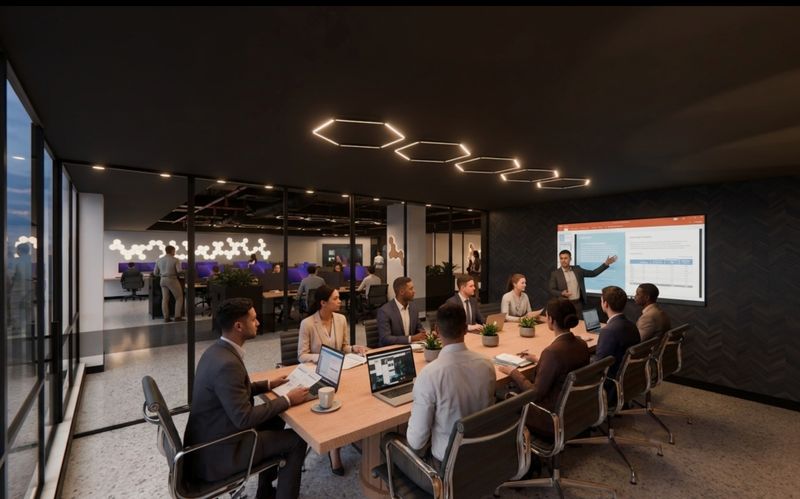
A connected workspace puts the daily work of the business in one environment, with shared memory underneath it. When an Agentic Citizen prepares a client update, it can see the project status, the conversation history and the financial position without anyone assembling them first.
SynAgentics mOS is built around this idea. Meta Space is the workspace where a launched venture runs, and Studio is the workspace for founders before they launch. Both sit on the same foundation, so the work moves with the founder when the venture launches.
The Monday report, revisited
In a connected workspace the same weekly report assembles itself from work that has already happened. The Agentic Citizen responsible for reporting reads the live numbers, drafts the commentary and flags the two items that need a human decision. The founder reads, adjusts and sends. Two hours becomes ten minutes, and the ten minutes are spent thinking.
What shared memory makes possible
- Onboarding that starts with context, not a blank page.
- Decisions that carry their history with them.
- Reporting that assembles itself from work already done.
- Continuity when a person leaves or a role changes.
A fair caution
Consolidation is not automatically better. A single tool that does everything badly is worse than three that each do one thing well. The goal is not fewer logos. The goal is connection: shared context, clear ownership and no manual copying between systems.
A simple audit to try
List every tool your business pays for. Next to each, write what information it holds and who moves that information elsewhere by hand. The manual transfers are where the patchwork is costing you most, and they are the best places to start.
If you want to see what a connected workspace looks like in practice, the next step is a Discovery conversation.